Blog
The Past (Part 2 of 4)
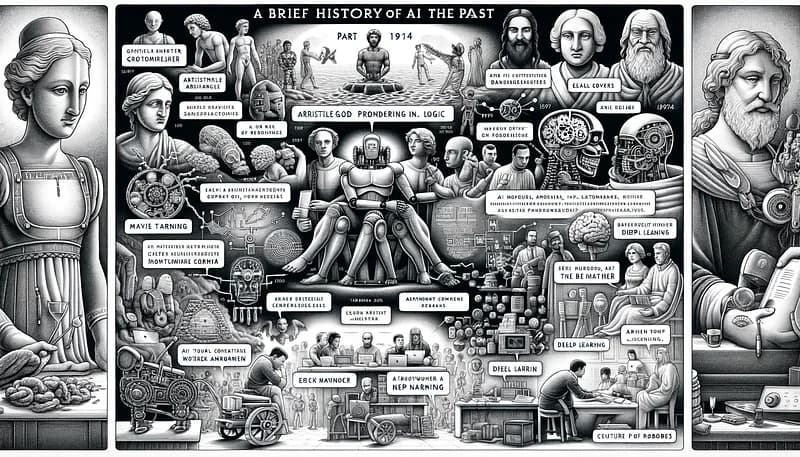
Generated by DALL·E with the prompt: "Wide format illustration to represent 'A Brief History Of AI - The Past (Part 2 of 4)' in a black and white, pencil-drawn cartoon style" - DALL·E. Struggles with spelling.
Introduction
Welcome back to our journey through the history of artificial intelligence in the second installment of my four-part series, A Brief History of AI - My Journey, Past, Present, and Future. In my previous post, I shared my personal journey and history with AI, from a childhood fascination with robotics to co-founding a tech company.
Today, we'll dive into the origins of AI, tracing its roots from ancient myths to the birth of modern AI research.
The Ancient Beginnings: Myths and Automatons
As someone who has always found the concept of artificial intelligence fascinating, I can't help but marvel at its ancient beginnings. The stories of mythical creatures and intelligent machines from ancient times resemble the imagination of a modern child, full of wonder and curiosity about the possibilities of technology.
The ancient Greeks told tales of Hephaestus, the god of craftsmanship, who created mechanical servants, and the bronze giant Talos, an early depiction of an autonomous machine. These stories captivated my imagination, reminding me of the excitement I felt as a child when I first dreamed of robots and intelligent machines.
Similarly, the Jewish folklore of the Golem, a clay figure brought to life through mystical means, sparked my interest in the ethical and creative aspects of creating life-like beings. It's fascinating to see how these ancient narratives explored themes that are still relevant in today's discussions about artificial intelligence.
The fascination with creating life-like intelligence wasn't limited to myths and legends. In ancient China and Greece, inventors created mechanical figures that could perform simple tasks, showcasing an early desire to mimic life through machinery. The ingenuity of these ancient automata is a testament to the timeless human aspiration to understand and replicate the principles of life and intelligence.
Looking back at these ancient beginnings, I realize that the stories of Hephaestus, the Golem, and the ancient automata resonate with the childlike wonder that still drives our curiosity and creativity in the field of AI today. The journey from ancient myths to modern artificial intelligence is a reminder of the enduring human quest to bring our imagination to life. Children, in general, are much better at imagining new concepts because they haven't been exposed to as many limitations as to what is possible and what isn't feasible. We can all learn from children in this way.
Building on these mythological tales, we now turn our attention to the classical philosophers, whose intellectual inquiries laid another foundational aspect of AI's history.
The Philosophical Foundations
My fascination with artificial intelligence is deeply rooted in the philosophical questions posed by ancient thinkers about the nature of intelligence and consciousness. I often find myself using deductive reasoning in my work at Vast Reach, a skill that traces back to the ancient philosopher Aristotle.
Aristotle's exploration of logic and reasoning has profoundly impacted the development of AI. His work on syllogisms and deductive reasoning provided a foundation for symbolic AI, where logical rules and symbols are used to represent and manipulate knowledge. As someone who relies on deductive reasoning to make decisions and solve problems, I can appreciate the significance of Aristotle's contributions to the field.
The philosophical inquiries of ancient thinkers like Aristotle, Plato, and Descartes laid the groundwork for our modern understanding of intelligence and consciousness. They questioned the nature of thought, the relationship between mind and body, and the possibility of machines possessing intelligence. These questions are still central to AI research today, as we strive to create machines that can reason, learn, and understand the world.
The transition from philosophical speculation to practical application began with the advent of computational machines. The logic and reasoning principles developed by philosophers were translated into algorithms and computational models, forming the basis of early AI systems.
Considering my own use of deductive reasoning in managing and developing AI-driven solutions, I realize the deep connection between the philosophical foundations of AI and the practical applications we see today. The ability to reason and make logical deductions is not only a fundamental aspect of human intelligence but also a crucial component of artificial intelligence.
The Renaissance to the Industrial Revolution: The Dawn of Automation
My fascination with the mechanics of things began in my childhood, long before I entered the world of artificial intelligence and co-founded Vast Reach. I was the kid who took apart every remote-controlled car I owned to see how they worked and then put them back together. I was captivated by the magic of power windows in cars, often pushing the button repeatedly to watch them go up and down, much to the annoyance of my family.
This curiosity about the inner workings of machines resonates with the spirit of the Renaissance and the Industrial Revolution, a time of many significant advancements in mechanical engineering and automation. The era saw the rise of clockwork-based automata, intricate machines designed to mimic human and animal movements. These automata were not just entertainment marvels; they were tools for understanding the principles of mechanics and automation.
The fascination with automata during this period reflected a growing desire to replicate life and intelligence through machinery. The intricate mechanisms of these devices, with their gears, springs, and levers, demonstrated early principles of automation and control systems. These principles underpin modern AI, where we strive to create machines that can complete complex tasks autonomously.
My curiosity about tinkering with toys and developing intelligent systems is what drove me to dismantle my remote-controlled cars as a child. That is also the same curiosity that fueled the inventors of the Renaissance and the Industrial Revolution. Their innovations laid the groundwork for the complex automation and control systems crucial to modern AI.
The 20th Century: The Birth of Modern AI
The formal beginning of AI as a scientific discipline can be traced to the mid-20th century, coinciding with my early dreams of building intelligent machines. In 1950, Alan Turing proposed the Turing Test as a criterion for machine intelligence, setting the stage for future AI research. This concept captivated my imagination, as I dreamed of creating a bot that could pass the Turing Test. Although I never achieved this in my early experiments, the idea of machines exhibiting human-like intelligence has been a guiding star in my journey.
The 1956 Dartmouth Conference is often cited as the birth of AI. This is where the term 'artificial intelligence' was first used, and the goals of AI research were laid out. As a young enthusiast, learning about this conference was a revelation, showing me that my personal fascination was part of a broader scientific endeavor.
This period also saw the development of early AI programs that utilized symbolic reasoning, a method that involves the manipulation of symbols to represent and reason problems. The Logic Theorist, created by Newell and Simon, used symbolic reasoning to prove mathematical theorems. This approach to AI, where problems are solved through explicit manipulation of symbols according to logical rules, resonated with me as it mirrored how I approached problem-solving in my tinkering and programming.
The progress made in these early days of AI research was inspiring. It showed that machines could be programmed to perform tasks that required human-like reasoning. As I continued to explore the field, I became fascinated by the potential of AI to mimic and even surpass human capabilities in certain domains.
Today, I look back on these early dreams with a sense of awe and gratitude. The technology we work with now has surpassed what I once imagined possible. While I may not have built a bot that passed the Turing Test, I feel blessed to be part of an era where AI technology can achieve remarkable feats, pushing the boundaries of what we once thought possible. While the scientific community laid the groundwork for AI, the world of science fiction provided a parallel narrative, shaping public perception and inspiring technological aspirations.
The Influence of Science Fiction on AI
Science fiction has been a profound source of inspiration in my journey with artificial intelligence, serving as a bridge between imagination and reality. I wanted to make sure to include a section that briefly highlights the visionary works of authors from the 19th century to modern times, which have not only entertained but also shaped my understanding of AI and its potential.
In the 1800s, novels like Mary Shelley's 'Frankenstein' (1818) explored the creation of artificial life and the ethical responsibilities of creators, themes central to modern AI discussions. 'The Steam Man of the Prairies' by Edward S. Ellis (1868) featured a steam-powered robot, reflecting the era's fascination with automata. 'The Mummy!: Or a Tale of the Twenty-Second Century' by Jane Webb Loudon (1827) and 'The Senator's Daughter' by Edward Page Mitchell (1879) depicted societies with advanced technology, including automata and legislative machines, foreshadowing modern robotics and AI decision-making systems.
Moving into the 20th century, Isaac Asimov's 'I, Robot' series (first published in 1950) introduced the famous Three Laws of Robotics, influencing discussions on AI ethics. Ray Bradbury's 'Fahrenheit 451' (1953) and Arthur C. Clarke's '2001: A Space Odyssey' (1968) envisioned futures where technology, including AI, plays a central role in society. Clarke's other works, like 'Rendezvous with Rama' (1973) and 'The City and the Stars' (1956), further explored the implications of advanced computing and AI-driven societies.
In 'The Man in the Moone' (1638) by Francis Godwin, the protagonist, Domingo Gonsales, travels to the moon using a vehicle pulled by a flock of geese. While the mode of travel is unbelievable and not mechanical, the concept of humans venturing beyond Earth reflects early imaginings of space exploration. This theme has become central to modern science fiction and real-world space technology.
'Do Androids Dream of Electric Sheep?' by Philip K. Dick (1968) and Stanislaw Lem's 'Solaris' (1961) delved into themes of identity, consciousness, and human-AI interactions, raising questions still relevant in today's AI discourse.
'The Difference Engine' by William Gibson and Bruce Sterling (1990), set in an alternate Victorian era, speculated on the impact of early computing technology, while Jules Verne's 'Paris in the Twentieth Century' (written in 1863, published in 1994) envisioned a technologically advanced society with automated machines.
As someone currently working on a platform that utilizes AI, I often find myself drawing on the ethical and philosophical questions raised in these works as we navigate the challenges and opportunities of creating intelligent systems. The speculative worlds created by these authors have served as a testing ground for ideas that have influenced real-world AI development.
Science fiction continues to be a valuable source of inspiration and caution for those of us working in AI. It reminds us to dream big and consider our creations' ethical and societal implications. While science fiction expanded our imagination, the journey from fiction to reality faced challenges.
Early AI Research and the First AI Winter
Early research efforts paved the way for AI's development and led to the first AI winter, marked by excitement and setbacks. The excitement of the early years of AI research led to significant achievements that laid the groundwork for the field as we know it today.
One of the most influential developments was the creation of ELIZA, an early natural language processing program developed by Joseph Weizenbaum in the mid-1960s. ELIZA was designed to simulate conversation and could interact with users in a way that was remarkably human-like for its time. The ELIZA program was a massive inspiration as I embarked on my journey to create a conversation simulator. It showed me the potential of machines to understand and generate human language, a concept that has evolved into the sophisticated GPT models we work with today.
In addition to ELIZA, this period saw the rise of expert systems and AI programs that could mimic human expertise in specific domains such as medical diagnosis or financial analysis. These systems demonstrated the potential of AI to assist or even surpass human decision-making in specialized areas.
However, the initial optimism of the early years of AI research was met with significant technical limitations. The symbolic AI approach relied on manually coded rules and logic and struggled with handling uncertainty and learning from data. This led to the first AI winter, where we saw reduced funding for AI research. It lasted from the mid-1970s to the early 1980s.
I believe this downturn was a crucial turning point in the history of AI. The first AI winter forced researchers to confront the limitations of existing approaches and paved the way for new paradigms, such as machine learning, which have since become central to AI research. However, I also can't help but wonder how much further along we might be in our quest for artificial general intelligence (AGI) if the funding and enthusiasm for AI had not dwindled during this time.
As we continue to push the boundaries of AI, the lessons learned from the first AI winter remain a reminder of the importance of balancing optimism with a clear-eyed assessment of the challenges that lie ahead. Despite the setbacks of the AI winter, the field experienced a revival in the 1980s, marked by the emergence of expert systems and the rise of machine learning.
The Revival: Expert Systems and the Rise of Machine Learning
The 1980s marked a pivotal moment in the history of artificial intelligence, characterized by a resurgence of interest and investment in the field. The success of expert systems in commercial applications largely drove this revival. Expert systems, which utilized rule-based logic to replicate the decision-making process of human experts, demonstrated the practical value of AI in domains such as medical diagnosis, financial analysis, and geological exploration. These systems provided reliable solutions to complex problems, showcasing the potential of AI to enhance human expertise.
However, the shift towards machine learning in the 1990s truly transformed the landscape of AI research. In contrast to the rigid, rule-based approach of expert systems, machine learning empowered computers to learn from data, adapt to changing scenarios, and enhance their performance over time. This significant paradigm shift broadened the horizons for AI applications and research.
One of the most significant advancements during this period was the development and implementation of neural networks for pattern recognition. Neural networks are designed to behave like the human brain, made up of layers of interconnected nodes that handle and transmit information. By fine-tuning the connections among these nodes, neural networks can learn to identify patterns within data. This capability makes them exceptionally useful for tasks like image recognition, speech-to-text transcription, natural language processing, and predictive analytics.
I vividly remember taking my first course on neural networks in college and being amazed by their potential despite their slow processing speeds at the time. The progress since then has been astounding. The resurgence of neural networks was fueled by improvements in computing power and the availability of large datasets, which allowed researchers to train more complex models. Pioneering work in this area led to the development of algorithms like backpropagation, which enabled neural networks to learn and refine their parameters more effectively.
The revival of AI in the 1980s and 1990s set the stage for the explosive growth of machine learning and neural networks in the following decades. The advancements in pattern recognition and other AI technologies during this period laid the foundation for the development of deep learning, which has since revolutionized the field of artificial intelligence. It's incredible to see how far we've come from those early days of slow neural networks to the powerful deep-learning models we work with today.
The revival in AI research set the stage for a new era. As we entered the new millennium, AI transitioned from the confines of research labs and niche applications to gain mainstream visibility and widespread adoption.
The 2000s: AI Goes Mainstream
The turn of the millennium marked a period of rapid advancement and mainstream adoption of AI technologies. During my school years, I witnessed firsthand the emergence of AI applications that captured the public's imagination. One of the most iconic AI applications of this era was SmarterChild, a chatbot available on AOL Instant Messenger and MSN Messenger. Launched in 2000, SmarterChild was an early example of a conversational AI that could provide users with information, entertainment, and even rudimentary conversation. I had the pleasure of interacting with SmarterChild and was blown away by how advanced it seemed at the time. It made me realize that AI was becoming more accessible to the general public and that we were on the cusp of a new era in technology.
This decade also saw the development of more sophisticated machine learning algorithms and the increasing use of AI in various industries, from finance to healthcare. IBM's Watson's triumph on the quiz show 'Jeopardy!' in 2011 further demonstrated AI's capability to comprehend and analyze natural language. Witnessing Watson's victory on 'Jeopardy!' reinforced my belief that the Turing Test, a benchmark for machine intelligence, would be passed in the not-so-distant future. However, I also recognized that the Turing Test is a moving target, with the AI community often debating its criteria and relevance.
As AI continued to evolve, it became clear that we were moving towards a future where conversational agents and virtual assistants would become an integral part of our daily lives. This era of AI going mainstream was a formative period for me, shaping my interest and career in artificial intelligence. It was a time of excitement and possibility as we began to glimpse the transformative impact of AI on society.
The 2010s: Breakthroughs in Deep Learning and NLP
The 2010s were a transformative decade for artificial intelligence, marked by groundbreaking advancements in deep learning and natural language processing. One paper that stands out to me as the most influential of this era, and perhaps of my lifetime, is 'Attention Is All You Need' by Ashish Vaswani, published in 2017. This paper introduced the Transformer architecture, which revolutionized how machines understand and generate human language.
At the heart of the Transformer architecture is the self-attention mechanism. This innovative approach allows the model to 'pay attention' to different parts of an input query/sequence when producing each part of the output sequence. In simpler terms, self-attention enables the model to dynamically weigh the relevance of each word in a sentence to every other word. For example, when processing the word 'bank' in the sentence 'I went to the bank to deposit money,' the model can use self-attention to determine whether 'bank' refers to a financial institution or the side of a river based on the context provided by the other words in the input query.
This ability to capture context and relationships between words significantly differs from previous sequence processing methods, which often struggled with long-range dependencies. The Transformer's use of self-attention allows it to process entire sequences simultaneously, leading to more efficient training and better handling of complex linguistic structures.
The impact of the Transformer architecture has been profound. It paved the way for the development of models like Claude and GPT (Generative Pre-trained Transformer), which have set new standards for performance in a wide range of NLP tasks. As someone deeply immersed in the field of AI, I find the innovation of the Transformer to resonate with me profoundly. It's not just about the technical advancements but the doors it has opened for more sophisticated AI applications.
We are now closer than ever to realizing AI's full potential in understanding and interacting with human language. This paper and the subsequent developments in deep learning and NLP have been pivotal in shaping the direction of AI research and applications, influencing our work at Vast Reach and the broader AI community.
Conclusion: A Journey Through AI's Past to Its Bright Future
Tracing the history of AI, we see a remarkable journey from the ancient myths of Hephaestus and the Golem to today's sophisticated technologies. This journey, fueled by human curiosity and ingenuity, has transformed our understanding of intelligence and the potential of machines.
As we move from the philosophical foundations laid by thinkers like Aristotle to the groundbreaking developments in deep learning and NLP, we witness the evolution of AI from a concept of myth to a reality of science.
Now, in what I like to call the 'AI summer,' we are experiencing an explosion of AI innovation and application, a stark contrast to the AI winters of the past.
In the next installment of this series, we'll delve into the present state of AI, examining its current capabilities, applications, and challenges. Stay tuned for Part 3, where we'll navigate the contemporary landscape of artificial intelligence.