Blog
My Journey, Past, Present, and Future (Part 1 of 4)
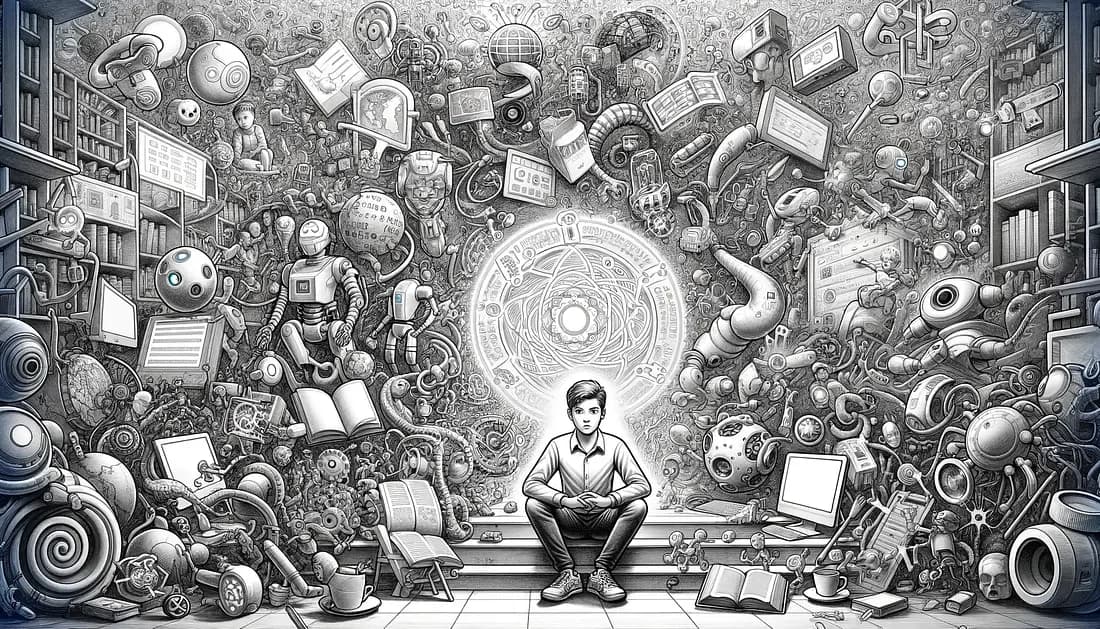
Generated by DALL·E with the prompt: "Wide format illustration to represent 'A Brief History Of AI: Me, Past, Present, and Future (Part 1 of 4) - Introduction to Part 1: My Personal Journey with AI.' in a black and white, pencil-drawn cartoon style"
Introduction
Welcome to the first installment of my four-part series, A Brief History of AI - My Journey, Past, Present and Future. In this series, we'll explore my personal journey with AI, delve into its historical development, examine its current state, and speculate on its future potential.
Me: My Personal Journey with AI
I went from a young boy fascinated by robotics living in Philadelphia to a co-founder of a cutting-edge tech company, my path has been shaped by my passion for AI and its potential to transform our world. In this first part, I'll share the experiences and milestones that have defined my relationship with AI. You'll get a glimpse into how a childhood curiosity turned into a lifelong pursuit, and how my personal and professional experiences have intertwined with the development of AI technology. I am not a PhD in the field but I've used applied AI to solve real-world business problems, and that is something I am very proud of.
So, buckle up as we embark on this journey together, starting with my story. Stay tuned for the upcoming parts, where we'll explore the past, present, and future of AI, and the impact it has on our lives and society.
The Early Years: A Childhood Fascination with Robotics
Growing up in a single-parent household in Philadelphia, PA, my journey into the world of AI and programming was anything but ordinary. From a young age, I was captivated by the possibilities of technology, fueled by my love for sci-fi movies like Terminator, I-Robot, and my favorite, Short Circuit. The opening scene of Short Circuit, where the main character is in his robotics lab surrounded by a bunch of his quirky robotic creations, left a lasting impression on me and sparked my obsession with robotics.
At the age of 10, I was introduced to Isaac Asimov's stories, and 'Robbie' captured my imagination. Its portrayal of a robot's unwavering loyalty and the pure, innocent friendship it shares with a young child made me want to build a robot for myself. This led me to muster up the courage to ask my mother for the Robotics Invention System 2.0, a hefty investment of $200 for my mother. Using the microcontroller and array of sensors that came with the kit I would be able to build robots that could mimic real beings that interact with their environment. On Christmas day when I was 11, my mother gifted me exactly what I asked for, and it changed my life forever.
My passion for robotics took a significant turn when I was 13. I was enrolled in a summer college course at Temple University, and I found myself among incoming college freshmen learning to program a microcontroller and build a robot. Thanks to my mother, who worked at Temple and mistakenly enrolled me in the course for what she thought was a summer camp, I got my first real exposure to AI under Dr. John Helferty. I vividly remember Dr. Helferty being confused at my presence in the classroom, he called my mother after the first class, she cleared things up and he let me stay in the course! I learned to code, breadboard circuits, and solve challenging logic problems. At the end of the course, there was a robot maze and obstacle course competition in which I finished second. Dr. Helferty even offered a TA position the following summer! As I entered high school, my fascination with AI and programming continued to grow.
High School and Beyond: Expanding My AI Horizons
High school was another turning point. Accepted into the High School of Engineering and Science (HSES), I immersed myself in programming and engineering. I was fortunate that my school offered computer science and engineering courses. Armed with a TI-83 calculator, I taught myself TI-Basic and created video games during class. I remember staying up late to perfect a game I was programming on my TI-83 calculator, fueled by the excitement and power of bringing my ideas to life. I participated in First Robotics and started a robotics club, building on my connection with Dr. Helferty, who sponsored our First Robotics team. My first chatbot, which I dubbed Wil's Conversation Simulator, was a rudimentary program in C++, that came to life during my freshman year after taking an Intro to C++ course. It utilized basic IFTTT (If This Then That) decision tree logic, regular expressions, and tokenization to simulate conversations. It wasn't a great program but I was obsessed.
The journey progressed after my junior year in high school with a summer research and mentorship program at Drexel University. I worked under Dr. Pragnesh Jay Modi. Here, I delved into game theory algorithms like minimax and neural networks for board games, an experience that further fueled my passion. I am forever grateful for the knowledge that Dr. Modi imparted to me. Sadly, Dr. Modi passed away at a very young age, read more about his influential work in the field of AI here (he was a true pioneer): https://teamcore.seas.harvard.edu/memory-dr-pragnesh-jay-modi
College and Professional Life: Deepening My AI Expertise
College at Rensselaer Polytechnic Institute (RPI) broadened my horizons. At RPI, I delved deeper into AI, learning about neural networks, databases, data structures, and algorithms. I also explored web development and big data which broadened my technical skills. While my technical studies provided me with skills to build software solutions, I found that a course called IT & Society taught by Dr. Atsushi Akera, was the most influential course I've ever taken.
We would like you to recognize that nearly all of the judgments we make about science and technology have their subjective components. Who benefits? Who gets left behind? What is progress and how do science and technology contribute to or detract from our higher goals? Also, what makes new technologies exciting? What gets buried in our rush to try something new? Instead of asking 'Why not change the world,' as we often say here at RPI, we want you to consider just what kind of world you would like to create through your engineering and scientific work.
During college, I also began my first step towards becoming a professional with a job at Rushordertees.com, where I honed my coding skills and learned about CRM (Customer Relationship Management) software. I was able to build and help architect a CRM platform from scratch that applied search algorithms, data structures, and many other fundamental concepts that I learned at school. Instead of a classroom or computer lab, I was using these skills in the real world! I found my true purpose. As you will read later in this post CRM, will be a big part of my life.
Transitioning from academia to the professional world, my passion for AI continued to drive my career choices. Post-college, I joined a software consulting firm in Manhattan, worked on dozens of projects, and learned how to solve line-of-business problems with Azure cloud, IAC (Infrastructure As Code), CI/CD (Continuous Integration and Deployment), Scrum/Agile, SDLC Architecture, Busienss Analytics, Knowledge Bases like SharePoint, LUIS (Language Understanding Intelligence Service) and the Vision API. What's awesome was that after a couple of promotions, I was given the opportunity to help lead AI projects. One memorable project involved developing an AI-powered tool for a law firm that analyzed SEC filings to inform business decisions. After five years, many projects, and a few public talks at Microsoft about the democratization of AI, I decided to co-found Vast Reach.
Co-Founding Vast Reach: Bringing AI to Small Businesses
Vast Reach, the company I co-founded, is a CRM and Marketing Platform that simplifies automation for small businesses, enabling them to send text messages and emails effortlessly from any device. Our platform stands out for making it incredibly easy to build automated marketing funnels and to train an AI (VastGPT) that leverages a business's knowledge to generate relevant content for email campaigns, SMS campaigns, surveys, and web forms. VastGPT can also provide one-click responses to sales and customer service inquiries via email and SMS. By simply uploading or pasting business knowledge, the system is trained almost instantly. I plan to share insights on how other companies and developers can architect similar solutions in future posts. If you're interested in leveraging such a system for your marketing or customer service project/business, visit us at vastreach.com for more information.
One of our recent innovations is an AI-powered automatic prioritization system for Jira. It understands our current and previous work, as well as our business goals, details, and documentation. Utilizing a unique algorithm I developed, combined with some LLM magic, it prioritizes Jira Tickets, sorts them, and provides reasons for their prioritization, saving countless hours. I'll be sure to delve into this topic in a different post, stay tuned for that too.
Conclusion: Reflecting on My AI Journey and Looking Ahead
Through my adventures in AI, from building robots to developing AI business solutions, I've discovered the power of storytelling in creating captivating and meaningful AI interactions. My journey illustrates how a childhood curiosity can evolve into a lifelong passion, shaping one's career and contributions to the ever-evolving field of artificial intelligence.
Now that we've journeyed through a small glimpse of my personal experiences, it's important to acknowledge that they are but a grain of sand within the larger narrative of AI's evolution. In the next installment, 'The Past: Unveiling the Origins of AI,' we will dive into the historical events and breakthroughs that have laid the foundation for today's AI landscape. Stay tuned for Part 2 of this series over the next few weeks!